
Frequently Asked Questions
Answers to the questions we hear most often. Can't find yours? Get in touch.
It depends on the model type:
· Stackable — Expandable: Stackable all-in-one models support capacity expansion by adding extra battery packs. Modular parallel design, plug-and-play, BMS auto-identifies new modules.
· Wall-mount — Check first: Depends on hardware design and BMS communication protocol. Some models do not support external expansion. Confirm the spec sheet lists "expandable / scalable" before purchase.
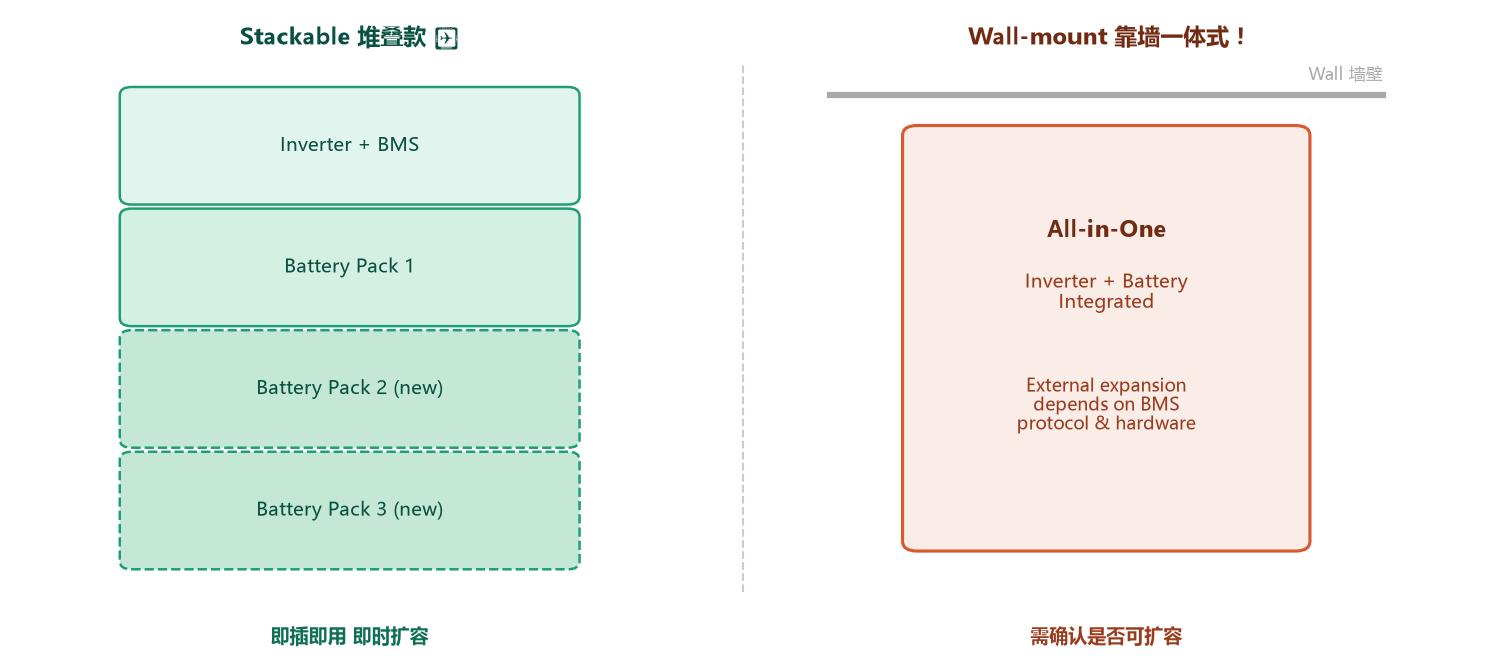
Figure: Expansion Method Comparison
Expansion guidelines:
· Same batch & spec: Use identical brand, model, and batch to avoid performance degradation from mixing old and new batteries
· Voltage matching: New pack nominal voltage must match the original system (e.g., 48V / 51.2V)
· BMS compatibility: Battery management system must support multi-pack parallel communication to prevent charge imbalance
· Installation space: Ensure adequate room and ventilation for additional modules
Never mix different battery chemistries (e.g., LFP with lead-acid) — this causes BMS misjudgment, charge/discharge disorder, and potential equipment damage. It cannot power all home appliances. High-power devices such as air-conditioners and electric water heaters generate large inrush current (3–5× rated power) and may exceed load limit. Prioritize critical loads — fridge, lighting, router — during outages.
The table below lists typical running wattage, inrush multiplier, and backup priority:
Appliance Running power (W) Inrush surge Backup priority LED light 5–50 None ★★★ High Router / modem 10–20 None ★★★ High Phone charger 5–25 None ★★★ High Laptop 50–100 None ★★☆ Medium TV (55″) 100–200 None ★★☆ Medium Refrigerator / freezer 100–400 3–5× ★★★ High Desktop PC 150–350 None ★★☆ Medium Rice cooker 500–900 None ★☆☆ Low Microwave oven 800–1200 None ★☆☆ Low Washing machine 300–500 2–3× ★☆☆ Low Electric water heater 1500–3000 None ✗ Not recommended Air conditioner (1.5 HP) 1000–1500 3–5× ✗ Not recommended For ordinary households, 6 kW–8 kW continuous power all-in-one units are mainstream for daily essential loads. Choose 10 kW or higher if many high-power appliances are present.
Caution: Inductive loads like AC and water heaters draw 3–5× rated current at startup. Even if total wattage is within limit, transient surge may trigger overload protection. Use these appliances one at a time, staggered — never start simultaneously. For shops suffering frequent blackouts,LFP (lithium iron phosphate) battery pack is the preferred choice.
Why LFP over lead-acid / gel batteries?
- 4,000+ cycle life — 5–8× longer than traditional lead acid battery, lower total cost of ownership
- Superior high-temperature stability — minimal thermal runaway risk in variable shop environments
- 90% depth of discharge (DOD) vs. gel battery's typical 50%, delivering more usable energy per rated kWh
- Compact & lightweight — fits in limited commercial space
Capacity selection depends on shop type, actual load wattage, and required backup duration. See the recommendation table below:
Shop type Typical equipment Recommended capacity Est. backup hours Small convenience store LED lighting, security cameras, POS terminal, router 5–10 kWh 6–10 hrs Medium shop (with fridge) Above + freezer / display cabinet, small microwave, fan 10–20 kWh 6–12 hrs Large shop / Restaurant Multiple freezers, cooking equipment, AC (staggered use) 20–40 kWh 4–10 hrs Pharmacy / Clinic Medicine fridge, temp control, lighting, camera, POS 15–30 kWh 8–24 hrs Small office / Internet cafe Multiple PCs, router, lighting, printer, water dispenser 10–20 kWh 4–8 hrs Sizing formula: Required capacity = (Total load W × backup hours) ÷ (DOD × inverter efficiency).
E.g., 2 kW load, 8 hrs backup, 90% DOD, 90% efficiency → 2×8÷(0.9×0.9) ≈ 19.8 kWh → choose 20 kWh pack.